

A Natural, OTC Option Worth Knowing About
Issue 6: The Other Half of the Equation — Progesterone
We talk a lot about estrogen. Hot flashes, night sweats, brain fog… estrogen gets the spotlight. But it’s only half the story.
Here’s something that doesn’t get nearly enough attention: about 45 million women in the U.S. are currently navigating menopause, and millions more will join them this year. Given how long we’re all living now, most women can expect to spend a third to half of their adult lives in some state of hormonal transition. That’s not a small window. That’s most of your life.
Progesterone is the quiet partner in this whole conversation, and it deserves more credit than it gets.
It’s not just a “female cycle” hormone
Most people think of progesterone as something that only matters for periods or pregnancy. But it’s actually made in the adrenal glands and even the brain and nerves, in both men and women. It’s also a building block your body uses to make other essential hormones, including estrogen, testosterone, and the stress hormone cortisol. When progesterone runs low, it doesn’t just affect your cycle. It can ripple into sleep, mood, and how “steady” you feel day to day.
That’s why I hear this from patients all the time. They’re not in full menopause yet. Their bloodwork looks “normal.” But they don’t feel like themselves.
What makes OTC (over-the-counter) progesterone different
Unlike estrogen, which typically requires a prescription because of how it’s metabolized and the risks involved at higher doses, natural progesterone cream is available without one. It’s applied topically, usually to thin-skinned areas like the inner arms, chest, or neck, and absorbed gradually.
It’s not a miracle overnight. But for a lot of women, it’s a gentle, accessible way to support sleep, ease irritability, and take the edge off some of those early perimenopausal shifts, without jumping straight to a prescription.
A few things worth knowing
- Not all progesterone creams are created equal. Look for ones using bioidentical, USP progesterone, not synthetic progestins.
- Dosing matters more than people think. More isn’t better here.
- It’s not a fix for everything. If your symptoms are more severe, it might be time to discuss additional options, including prescription-strength support.
One caution
Natural progesterone isn’t right for everyone. It shouldn’t be used during pregnancy, and if you typically have heavy menstrual flow, that’s worth a conversation before you start.
My advice?
If you’ve been feeling off and haven’t been able to put your finger on why, a conversation about progesterone might be worth it. It’s not about jumping to conclusions. It’s about ruling things in or out and giving your body the support it’s asking for.
As always, I’m happy to talk through what might make sense for you.
-Bob
Want to go deeper? Two articles worth a read if you want the fuller picture:
- Natural Progesterone: Bringing Your Life (and Hormones) Into Balance
- Dr. Jonathan V. Wright Interview: Natural Progesterone
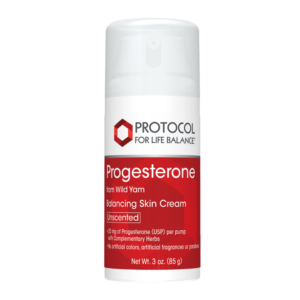
Protocol for Life Balance Wild Yam Progesterone Cream This is a bioidentical, USP-grade progesterone cream derived from wild yam, delivering 20 mg of progesterone per pump. It’s applied to smooth skin areas like the wrists, inner arms, throat, abdomen, or chest, once or twice daily, rotating spots as you go. General usage guidelines: premenopausal women typically use it for the 14 days leading up to their period, then stop and repeat the cycle. Menopausal women typically use it for 21 days, then take a 7-day break before starting again. As always, these are general guidelines. What works can vary person to person, so it’s worth adjusting based on how you feel or talking it through with your practitioner. It’s fragrance-free or lavender-scented depending on preference, free of parabens and artificial colors, and made with complementary herbs. |
|
You’ll find Protocol for Life Progesterone and more in my Fullscript dispensary. Available in unscented and lavender. Sign up for a free account! |